
6th Biennial Conference
6th Biennial Conference (2019)
Judicial Conduct in the Caribbean: Ethical, Political and Social Dimensions
Hosted by Judiciary of Belize
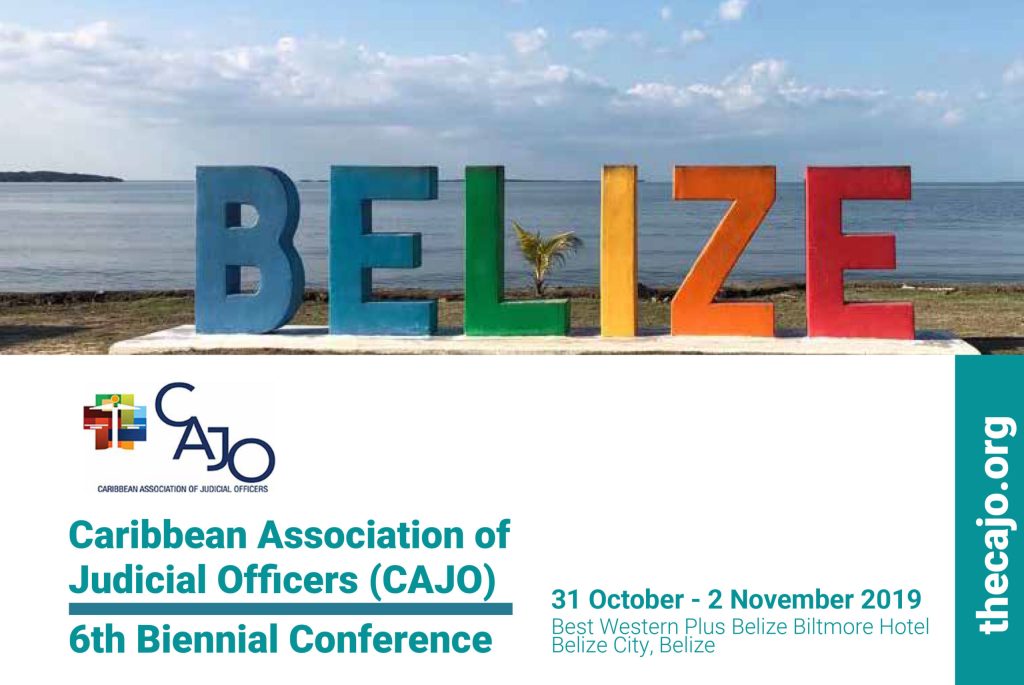
Conference Schedule
Additional Information
Programme
Conference schedule
-
REGISTRATION
-
Opening Ceremony
Chair: The Hon Mr Justice Courtney Abel
Procession of Flags Seating of Head Table Opening Prayer National Anthem
-
-
-
-
Cultural Item
-
Introduction of Keynote Speaker
The Hon Mme Justice Maureen Rajnauth-Lee
-
Keynote Address
-
Judicial Conduct in the Caribbean: Ethical, Political and Social Dimensions
Dr Terrence W Farrell
-
The JURIST Project Presentation: Highlighting Major Achievements
Mrs Gloria Richards-Johnson
-
Plenary: Developments in the Rule of Law in Africa and the Caribbean
Chair: The Hon Mr Justice Adrian Saunders
Africa: The Hon Mr Justice Kashim Zannah & Ms Vanessa Egert Caribbean: Dr Lee Cabatingan , Dr Se-shauna Wheatle , Mr Douglas Mendes SC At the end of the session, participants will be informed about:
-
Breakout: Complex Criminal Trials
Chair: The Hon Mr Justice Jacob Wit
Panellists: The Hon Mme Justice Alice Yorke-Soo Hon & The Hon Mr Justice Murray Shanks
At the end of this session, participants will be able to: a. Identify key elements of a complex criminal trial that require special focus, and b. Identify tools/methods that can be used to effectively and efficiently manage complex criminal trials.
-
Breakout: Rights of Indigenous Persons
Chair: The Hon Mme Justice Sandra Kurtzious
Panellists: The Hon Mme Justice Antoinette Moore & The Hon Mr Justice Winston Anderson
At the end of this session, participants will be able to: a. Identify some key issues which indigenous persons face in the judicial system, and b. Identify developments in the law in relation to the rights of indigenous persons.
-
Breakout: Environmental Pollution and Human Rights – Challenges and Solutions
Chair: His Honour Mr Sunil Sookraj
Panellist: Professor David Boyd At the end of this session, participants will be able to: a. Identify some key issues which indigenous persons face in the judicial system, and b. Identify developments in the law in relation to the rights of indigenous persons.
-
Breakout: Pre-trial Detention
Chair:
Panellists: The Hon Mr Justice Iain Morley & The Hon Mr Justice Colin Williams
At the end of this session, participants will be able to: a. Identify some key issues which surround pre-trial detention, and b. Formulate solutions to effectively deal with these issues.
-
Breakout: Judicial Stress
Chair: The Hon Sir Marston Gibson K.A .
Panellist: Dr Joseph Sadek At the end of this session, participants will be able to: a. Describe some main causes of judicial stress, and b. Identify interventions to effectively deal with judicial stress
-
Breakout: Eliminating Delay through the use of ADR
Chair: The Hon Mr Justice Shiraz Aziz
Panellists: The Hon Nancy Flatters QC , The Hon Mr Justice Francis Belle, Ms Julie-Ann Ellis Bradley
At the end of this session, participants will be able to: a. Identify some main ADR practices, and b. Explain how these ADR practices can be used to eliminate delay.
-
Judges’ Forum
-
Magistrates’ Forum
-
Registrars’ and Court Administrators’ Forum
-
Meeting of CAJO Executive and Internal Elections Committee
Under the patronage of our Governor General, His Excellency Sir Colville Young, at the Bliss Centre for Performing Arts, you will experience history as you never have before. The cast of Jankunu Productionz of Belize will take you on an entertaining journey from the glorious Mayan civilization to the glory of Independence Day. Having sat and listened all day, we here in Belize know when it’s time to unwind. So immediately after the Bliss, we invite you to do just that at our Belizean Bram: A poolside party at the Biltmore Hotel featuring only Belizean fare. You can show off your Punta skills learnt the night before and when you’ve worked up a thirst, please don’t ask for a Heineken, demand a Belikin instead. Take a look below at our line-up of distinguished Chairs and Panellists for our Day One sessions! *we have included bios and photos that were received
-
The Hon Mr Justice Courtney Abel
Judge, Supreme Court of Belize Justice Courtney Ashton Abel of Belize is a national of Guyana and the UK and a Belonger of Anguilla. He is a member of the Hon. Society of Inner Temple and was called to the Bar of England and Wales in February 1980. He also engaged in the private practice of law, in a broad range of matters in the UK, Anguilla, the Eastern and wider Caribbean (including Guyana) and founded two separate law firms, Courtney Abel & Associates and Caribbean Associated Attorneys. In private practice over a period of some 40 years, in many countries and continents, he has appeared as junior Counsel in a wide range of matters, as well as leading Counsel in many complex civil and commercial matters, in many tribunals and all levels of the Courts system, including before the Judicial Committee of the Privy Council. Justice Courtney Abel has been a Justice of the Supreme Court Judge in Belize since October 22, 2012, where he is assigned to hear Civil matters and is well-known for the elimination of any backlog, his efficient no-nonsense management of cases and for his timely delivery of oral, draft and written judgments. He has also established quite a regional reputation as a speaker and for having drafted and then successfully implemented the system of Mediation; as well as for having conceived the innovative system of Court-connected Arbitration which is about to be passed into law. He has been the only Chair, since inception 5 years ago, of their oversight National Committee under the watchful eye and keen support of the Chief Justice of Belize the Hon. Kenneth Benjamin. Opening Remarks: Thursday @ 8:10 a.m.
-
The Hon Mr Justice Peter Jamadar
Judge, Caribbean Court of Justice Justice Peter Jamadar obtained his Bachelor of Laws degree, UWI (Hons) in 1982 and his Legal Education Certificate from the Hugh Wooding Law School, St. Augustine in 1984. In 1984 he was admitted to the Bar of Trinidad and Tobago. On September 15, 1997 he was appointed a Puisne Judge of the High Court and on October 1, 2008 he was elevated to the Court of Appeal of Trinidad and Tobago. Justice Jamadar has served on several committees within the Judiciary of Trinidad and Tobago, including the Rules Committee of the Supreme Court (2002-19), the Bench Bar Committee (2008-19), and the Judicial Research Counsel Management Committee (2010-19). He was the fourth Chairperson of the Trinidad and Tobago Judicial Education Institute (JEITT), having been appointed in 2009, he served as such until 2019. He has been a leader in the development and roll out of a Gender Protocol for the Judiciary of Trinidad and Tobago (2018). In June 2004, he completed the Commonwealth Judicial Education Institute’s (CJEI) Intensive Study Programme for Judicial Educators and is a Fellow of the CJEI; he is now Vice President (Programming) and a Faculty member of the CJEI. He also holds a Certificate in Training Judicial Trainers from the University College London Judicial Institute. Justice Jamadar is the current Interim Chairman of the Caribbean Association of Judicial Officers (CAJO). He is deeply involved in judicial education nationally, regionally and internationally. He is also currently engaged with the United Nations Global Integrity Network in the development of a Global Social Media Protocol for judicial officers; and in indigenous research on Mindfulness as an aid to Judicial integrity and performance. In July 2019, Justice Jamadar was appointed as a Judge of the Caribbean Court of Justice. Opening Remarks: Thursday @ 8:10 a.m.
-
The Rt Hon Mr Dean Barrow
Prime Minister, Belize The Right Honourable Dean Oliver Barrow was born in Belize City, Belize on March 2, 1951. In December 1983, as a member of the United Democratic Party (UDP), he officially entered electoral politics as a candidate for the Belize City Council elections, in which he was successful. In 1984, he vyed as the UDP’s representative for the Queen’s Square Electoral Division in the general elections, defeating Ralph Fonseca, the representative for the People’s United Party (PUP). He was appointed to Cabinet and served as Attorney General and Minister of Foreign Affairs from 1984-1989. Since 2008, in addition to Minister of Finance, the Prime Minister has also served as the substantive Minister of Natural Resources; Economic Development; Labour, Local Government and Rural Development; Energy, Public Utilities, Public Service and Elections and Boundaries. Prime Minister Barrow is also a very successful and well respected Attorney-at-Law. As a young man, Barrow attended St. Michael’s College in Belize City. He furthered his education at the University of the West Indies in Barbados (LL.B. 1973), the Norman Manley Law School in Jamaica (Certificate of Legal Education, 1975), the University of Miami School of Law (LL.M., 1981), and the University of Miami (M.A. International Relations). Greetings: Thursday @ 8:35 a.m.
-
The Hon Mr Justice Kenneth Benjamin
Chief Justice, Belize The Hon. Chief Justice Kenneth Benjamin is a national of Guyana and Antigua. He received his legal training from the University of the West Indies and the Hugh Wooding Law School in Trinidad and Tobago. He returned to Guyana where he practiced privately. He also served as a Magistrate and Assistant Judge Advocate for the Guyana Defence Force. He has served on the Court of Appeal in the Eastern Caribbean Supreme Court sitting in both St. Lucia and St. Vincent. He also served as the Presiding Judge for the Criminal Division of the High Court in St. Lucia. He has served as a High Court Judge in Antigua, British Virgin Islands and Grenada. He served as Chief Magistrate in Antigua and Barbuda. He was appointed as Chief Justice of Belize on September 15, 2011. He is a member of the Commonwealth Magistrates and Judges Association, a former Rotarian and a former cricket executive in Antigua. The Hon. Chief Justice Kenneth Benjamin is a Fellow of the Commonwealth Judicial Education Institute. Welcoming Remarks: Thursday @ 8:40 a.m.
-
The Hon Mme Justice Maureen Rajnauth-Lee
Judge, Caribbean Court of Justice Mme. Justice Rajnauth-Lee, a national of Trinidad and Tobago, took the Oath of Office as a Judge of the Caribbean Court of Justice at President’s House, Port of Spain, on March 27, 2015. She was formerly a Justice of Appeal of the Judiciary of Trinidad and Tobago. From October 1985 to January 2001, Mme. Justice Rajnauth-Lee worked in private practice in Chambers with Mrs. Valeria Ortiz Alcala S.C. in Trinidad and Tobago, in the areas of Commercial and Tax Litigation, Public and Labour Law, and family matters. She served as State Counsel in the Office of the Solicitor General from 1981 to 1985. Mme. Justice Rajnauth-Lee received her legal education at the Hugh Wooding Law School and the University of the West Indies, graduating in 1976 with a Bachelor of Laws (First Class). Mme. Justice Rajnauth-Lee serves as Vice-President of the Caribbean Association of Women Judges. She is a certified Mediator and a Fellow of the Chartered Institute of Arbitrators. She serves as Chair of the Sexual Offences Advisory Committee which provided advice and support to the JURIST Project, in the development of Model Guidelines for Sexual Offences and the establishment of the Sexual Offences Model Court in Antigua and Barbuda. Introduction of Keynote Speaker: Thursday @ 9:20 a.m.
-
Dr Terrence Farrell
Former Chairman, Economic Advisory Board (Trinidad and Tobago) Terrence W. Farrell has worked extensively in both the public and private sectors. He joined the Central Bank of Trinidad and Tobago in 1980 and was Director of Research (1984-1989) and later Deputy Governor (1992-1995) where he was involved in key policy initiatives including the debt restructuring and IMF programmes in 1987-1991 period, exchange control liberalization and the flotation of the Trinidad and Tobago dollar in 1993 and the central bank’s intervention of troubled financial institutions in the period 1986-1993. Within the private sector, he was Regional Manager for a regional IT Services company from 1995 to1997, Group Executive Director at Guardian Holdings Limited from 1998-2005, responsible for Strategy and Business Development and President of Guardian General Limited from 2005-2006. He was President of Business Insight Limited a strategy and business development consulting firm from 2006-2008 and Group Chief Executive Officer of One Caribbean Media Limited from 2008 to 2010. He now works in the areas of economics, strategy consulting and business development and legal advice and mediation. He is a director of Republic Bank Limited, Eastern Caribbean Financial Holdings Limited, TATIL and TATIL Life and CREDI, the Catholic tertiary education institute. Dr. Farrell studied Economics at the University of the West Indies, St. Augustine and at the University of Toronto where he obtained his Ph.D. in 1979, and also holds an LL.B (London) degree and the LEC from the Hugh Wooding Law School. He was admitted to practice law in Barbados and in Trinidad and Tobago in 2013 and is a Certified Mediator. He is a Fellow of the Institute of Banking and Finance of Trinidad and Tobago, a Member of the Chartered Institute of Arbitrators and a member of the Caribbean Corporate Governance Institute. He has published several scholarly articles in Economics, written a book on Central Banking in Trinidad and Tobago, and co-edited a book on Caribbean Monetary Integration. His latest book The Underachieving Society: Development Policy and Strategy in Trinidad and Tobago, 1958-2008 was published by UWI Press in 2012. He has served on several government-appointed committees addressing a variety of public policy issues, including the Vision 2020 Core Group, the Task Force on the Future of BWIA and The Economic Development Advisory Board of Trinidad and Tobago. Keynote Speaker: Thursday @ 9:25 a.m.
-
Mrs Gloria Richards-Johnson
Director, The JURIST Project Mrs. Richards-Johnson assumed the position of Director of the Judicial Reform and Institutional Strengthening (JURIST) Project on May 15, 2018. She is an Attorney at Law, is a former deputy Attorney General and Senior Corporations Counsel for the State of California, who prosecuted complex securities and other white-collar criminal crimes. She has designed, managed and implemented complex democracy and governance projects funded by Global Affairs Canada, the United States Agency for International Development (USAID), the European Union and other donors in the Caribbean, Africa, and the Middle East. She served on the Ad Hoc Committee of the UNODC which drafted the UN Convention against Corruption and advised governments of the Caribbean Community (CARICOM), Nigeria, Liberia, Iraq and Ghana on the establishment of legal and regulatory regimes to combat corruption, money laundering and financial crimes. She also served as Assistant General Counsel at the CARICOM Secretariat in Guyana. Ms. Richards Johnson has earned a Master of Laws (LLM.) degree (cum laude) in International and Comparative Law from the Vrije University of Brussels, Belgium, a Juris Doctorate (JD.) in Law and Bachelor of Arts (BA.) in Political Science from Howard University, Washington DC. The JURIST Project Presentation: Thursday @ 10:50 a.m.
-
The Hon Mr Justice Adrian Saunders
President, Caribbean Court of Justice Developments in the Rule of Law in Africa and the Caribbean: Thursday @ 11:10 a.m.
-
The Hon Mr Justice Kashim Hannah
Chief Judge, Borno State, Nigeria J ustice Zannah was appointed Judge of the High Court of Borno State, Nigeria in 1997 and Chief Judge in the year 2006. Currently a member of the National Judicial Council (NJC) and of its Performance Evaluation Committee, among others. He sits on the boards of several international bodies in the field of law and justice, like the International Society for the Reform of Criminal Law (ISRCL), International Institute for Justice Excellence (IIJE), The Hague and as Vice President of the Commonwealth Judicial Education Institute (CJEI) and Deputy President of the International Organisation for Judicial Training (IOJT). He was recently appointed into the Advisory Board of the United Nations Global Judicial Integrity Network (GJIN). Justice Zannah is a regular speaker, presenter and trainer at numerous national and international fora. He is regularly invited to Expert Group Meetings (EGM) of the United Nations Office on Drugs and Crime (UNODC) and the United Nations Development Program (UNDP), responsible for developing guidelines and programs for the justice sector. For the Deutsche Gesellschaft für Internationale Zusammenarbeit (GIZ), a resource person recently in Abidjan, Cote de Ivoire and San Jose, Costa Rica. He is a recipient of the Medal of the International Society for the Reform of Criminal Law (ISRCL) in 2012 and the United States National Centre for State Courts (NCSC) Distinguished Service Award in 2013. He is currently Chairman of the National Judicial Council (NJC) Judicial Information Technology Policy Committee (JITPO-COM) that is in the process of automating court processes in Nigeria. A Nigerian Case Management System (NCMS) is currently being rolled out for the three tiers of superior courts. The Nigerian Legal Email has also been designed and rolled out for service of court processes and other communication in the judicial ecosystem. Developments in the Rule of Law in Africa and the Caribbean: Thursday @ 11:10 a.m. Using Social Media in ways that Promote or Undermine Judicial Integrity : Saturday @ 10:15 a.m.
-
Ms Vanessa Egert
Legal Advisor, GIZ From 2004- 2010 Vanessa completed her legal studies at the University of Mainz. In 2011, she graduated with a Master of Law (LL.M.) from the University of Stellenbosch and then in 2014, she was successful at the Second State Exam at the Hanseatic Higher Regional Court Hamburg. From 2014-2015 she worked as an attorney- at-law at a law and tax firm in Hamburg and then from 2015-2016, as inhouse legal counsel at a wind turbine production company in Hamburg. In February 2017, she was appointed legal advisor to the Sino-German Legal Cooperation Programme of the Deutsche Gesellschaft für Internationale Zusammenarbeit (GIZ) GmbH, Beijing. And since November 2018 legal advisor to the regional project “Promoting the rule of law and justice in Africa”. Her areas of expertise include commercial law, private law, international law and the law of international organisations, and European law. She speaks German, English, French, and Mandarin Chinese. Developments in the Rule of Law in Africa and the Caribbean: Thursday @ 11:10 a.m.
-
Dr Lee Cabatingan
Assistant Professor, University of California, Irvine Dr. Lee Cabatingan holds a PhD in Anthropology, as well as a postgraduate degree in Law. Formerly a litigator in the United States, Dr. Cabatingan is currently faculty in the Departments of Criminology, Law & Society and Anthropology at the University of California, Irvine. Her research investigates how law and legal institutions impact projects of shaping and ordering the world, such as nation building, statecraft, region formation, and, most recently, the installation or contestation of private property regimes. She is particularly interested in how these processes unfold in postcolonial contexts. Dr. Cabatingan has conducted ethnographic research in Cuban and Anglophone Caribbean courts, including long-term fieldwork at the Caribbean Court of Justice. In the past two years, she has initiated a project in Antigua and Barbuda that explores the process of recovery following Hurricane Irma and its intersections with communal land ownership practices on Barbuda. Dr. Cabatingan is co-editor of the volume Global Perspectives on the Rule of Law (Routledge 2009) and has published her research in various peer-reviewed academic journals, such as the Law and Society Review and the Political and Legal Anthropology Review . Developments in the Rule of Law in Africa and the Caribbean: Thursday @ 11:10 . a.m
-
Dr Se-shauna Wheatle
Associate Professor of Law, Durham University Se-shauna Wheatle is an Associate Professor in Law at Durham Law School, where she teaches Comparative Constitutional Law and UK Constitutional Law. She was previously Lecturer in Law at Exeter College, University of Oxford. She achieved her Bachelor of Laws (LLB) at the University of the West Indies before attending the University of Oxford as a Rhodes Scholar to read for the Bachelor of Civil Law (BCL) and Doctor of Philosophy in Law (DPhil). Se-shauna has written a monograph, Principled Reasoning in Human Rights Adjudication, which was shortlisted for the Society of Legal Scholars Birks Prize 2018. Her current research interests lie in comparative constitutionalism, comparative human rights, common law constitutionalism and implied constitutional principles. Her work has been published in journals such as Public Law, the Journal of Comparative Law and the European Human Rights Law Review. She is also co-editor of the forthcoming Oxford Handbook of Caribbean Constitutions. Among other academic activities, she sits on the Scholarship Advisory Group of the Younger Comparativists Committee of the American Society of Comparative Law and the Organizing Committee of the Northern Public Law Forum. Developments in the Rule of Law in Africa and the Caribbean: Thursday @ 11:10 a.m.
-
Mr Douglas Mendes, SC
Senoir Counsel, Trinidad and Tobago Mr Douglas Mendes SC is a lawyer, former judge and academic. He was a judge of the Court of Appeal of Belize for the period March 2011 to March 2014 and a temporary judge of the High Court of Trinidad and Tobago during the period April to September 1998. He was also a lecturer in the Faculty of Law at the University of the West Indies (UWI) for a period of 14 years, ending in 2012, when he took up his judicial appointment in Belize. In 2003, he was appointed Senior Counsel and became a member of the Inner Bar of the Republic of Trinidad and Tobago. He has litigated numerous human rights, constitutional and administrative law cases as a senior legal practitioner across the Caribbean and before the Caribbean Court of Justice and the Judicial Committee of the Privy Council. He was the coordinator of the Coalition for Social Justice and Human Rights (1994-1997), the Vice President of the Caribbean Centre for Human Rights and the Honorary Legal Counsel of the International Planned Parenthood Federation. In 2011, Mr. Mendes completed a Master of Studies in International Human Rights Law at the University of Oxford (with distinction). He is currently the Chairman of the Securities and Exchange Commission and President of the Law Association of Trinidad and Tobago . Developments in the Rule of Law in Africa and the Caribbean: Thursday @ 11:10 a.m.
-
The Hon Mr Justice Jacob Wit
Judge, Caribbean Court of Justice Complex Criminal Trials: Thursday @ 1:45 .p.m
-
The Hon Mme Justice Alice Yorke-Soon Hon
Justice of Appeal, Supreme Court of Trinidad and Tobago Madame Justice Yorke-Soo Hon, Justice of Appeal of the Court of Appeal of Trinidad and Tobago, was admitted to the Bar in 1982 and was appointed to the Court of Appeal in October 2008. Prior to her appointment to the High Court Bench in 1997, Justice Yorke-Soo Hon had over 15 years practice at the Bar, more notably in Criminal Law. She obtained her LL.B from the University of the West Indies in 1980 and her L.E.C at the Hugh Wooding Law School where she serves today as an Associate Tutor in Criminal Practice and Procedure. From 2013 – 2016 she also tutored in Ethics, Rights & Obligations of the Legal Profession. Madame Justice Yorke-Soo Hon is a member of the Board of Trinidad and Tobago Judicial Education Institute and a fellow of Commonwealth Judicial Education Institute. She also holds a diploma in ‘Training Judicial Trainers’ from the University College of London. Madame Justice Yorke-Soo Hon has chaired a number of Committees, including the Bench Book Committee responsible for the publication of the Criminal Bench Book in Trinidad and Tobago in 2015. Madame Justice Yorke-Soo Hon was the Chairperson of the Sentencing Update Handbook which was published recently. She is also a member of the Criminal Justice Reform Committee (JURIST Project), and the Chairperson of the Magistrates’ Benchbook Committee which is expected to publish a Handbook for Magistrates in the English speaking Caribbean soon. She is also the Chairperson of the Implementation of the Criminal Procedure Rules 2017 Committee. She has done extensive training in Criminal Practice and Procedure with Judicial Officers both in Trinidad and Tobago and in the region. Complex Criminal Trials: Thursday @ 1:45 .p.m
-
The Hon Mr Justice Murray Shanks
Circuit Judge, London and South Eastern Circuit Murray read law at Cambridge and qualified as a barrister in Middle Temple in 1984. He practised as a barrister in commercial chambers at Fountain Court chambers in London until 2000. He took a post as an Acting High Court Judge of Belize in 2000 and subsequently sat as an Acting High Court Judge of the Eastern Caribbean Supreme Court in various jurisdictions in the period 2003-5. In 2003 he was appointed a Recorder in England and began to sit regularly hearing serious criminal cases with a jury in the Crown Court. In 2009 he was appointed a full-time Circuit Judge on the London and South Eastern Circuit. He spends most of the time hearing serious criminal cases with a jury at Snaresbrook Crown Court in the east end of London. He also sits several months a year in the Employment Appeal Tribunal hearing appeals from tribunals on employment and discrimination cases and in the (now renamed) Information Tribunal hearing appeals from the Information Commissioner in cases brought under the Freedom of Information Act 2000. Complex Criminal Trials: Thursday @ 1:45 .p.m
-
The Hon Mme Justice Sandra Kurtzious
Judge, Supreme Court of Guyana Justice Sandra Kurtzious is presently a Judge in the High Court of Guyana and presides in the Family Division. Where she was assigned since the opening of the Court in June of 2016. In addition to the Family Matters, at intervals, Justice Kurtzious also presides in the Civil and Criminal and the Full Court, in the Capital City Georgetown, as well as the two counties of Essequibo and Berbice. Prior to ascending the Bench in the year 2012, Justice Kurtzious was employed with the Guyana National Bank, and was Managing Attorney of the Guyana Legal Aid Clinic, and thereafter she started a General Private Practice in the year 2003, with focus mainly in the area of Family Law, Justice Kurtzious is affiliated with several Charitable and Non-Governmental Organisations, such as the Lions Club, the Advocates Guyana, the Guyana Association of Women Lawyers, the Guyana Association of Women Judges, and she is also a Trained Mediator and is presently pursuing a Diploma in General Psychology as a foundation to pursuing her Masters in Child Psychology. Rights of Indigenous Persons: Thursday @ 1:45 .p.m
-
The Hon Mme Justice Antoinette Moore
Judge, Supreme Court of Belize Justice Antoinette Moore is a judge in the Criminal Division of the Supreme Court of Belize. She has presided over the court in Belize’s capital city since 2014. In addition to her regular docket, Justice Moore is assigned all “trafficking in persons” cases in Belize. Prior to being elevated to the bench, Justice Moore as a human rights lawyer represented individuals and groups whose human rights had been violated by the State of Belize, including juveniles in conflict with the law, women and families, refugees, union activists, persons abused by the police, and indigenous peoples. Justice Moore has a Master’s degree in International Human Rights Law from Kellogg College, Oxford University in the UK. She earned her Bachelor of Arts from Lawrence University and her Juris Doctor degree from Loyola University in the United States and later also obtained a Legal Education Certificate from the University of the West Indies in Jamaica. Rights of Indigenous Persons: Thursday @ 1:45 .p.m
-
The Hon Mr Justice Winston Anderson
Judge, Caribbean Court of Justice T he Hon. Mr. Justice Winston Charles Anderson is of Jamaican nationality and upbringing. He was born in Saint Ann’s Bay and raised in Brittonville, Saint Ann, Jamaica. He attended the Brittonville Primary School and later the Ferncourt High School in Clermont, Saint Anns from which he transferred to the Saint Andrew Technical High School (STATHS) in Kingston. He entered the Faculty of Law, University of the West Indies (UWI) in 1980, and graduated in 1983 with the Degree of Bachelor of Laws, (Honours). From 1983 to 1984, he taught International Law, among other subjects, at the UWI Faculty of Law, whilst also pursuing the Masters in Law degree there. Dr Anderson was appointed the General Counsel of the Caribbean Community Secretariat on secondment from the University of the West Indies, 2003-2006, and in 2006 was appointed Professor in the Faculty of Law, University of the West Indies. Professor Anderson returned to the Faculty of Law in 2006 and was called to the Bar of Jamaica, also in 2006. He was appointed Executive Director of the Caribbean Law Institute Centre, in 2007, a position he held until June 2010. On June 15, 2010 Professor Anderson was sworn in as Judge of the Caribbean Court of Justice in a ceremony at King’s House, Jamaica, presided over by Governor General Sir Patrick Allen and attended by Prime Minister the Hon. Bruce Golding and Leader of the Opposition the Most Hon. Portia Simpson-Miller, as well as other local and diplomatic dignitaries. The Hon Mr Justice Anderson has the distinction of being the first Jamaican and the youngest judge ever appointed to the CCJ. Rights of Indigenous Persons: Thursday @ 1:45 .p.m
-
His Honour Mr Sunil Sookraj
Chairman, Environmental Commission of Trinidad and Tobago His Honour Sunil K. Sookraj is an Attorney-at-Law with over 20 years’ experience in corporate, contract, commercial and environmental law. He is qualified with a Bachelor of Laws Degree from the University of the West Indies and obtained his Legal Education Certificate from the Hugh Wooding Law School. He is also a member of the Local Bar and the Law Association of Trinidad and Tobago and has served as a past Vice President of the Assembly of Southern Lawyers. H.H. Sookraj is a member of the New York State Bar Association and the American Bar Association and a past member of the Association of International Petroleum Negotiators (AIPN). In addition to these qualifications, H.H. Sookraj has been trained in Environmental Law Dispute Resolution, Mediation, Judicial Writing, Climate Change, Sustainable Development and Project Management Essentials. During his tenure in the private sector, H.H. Sookraj practiced in several aspects of corporate governance and administration. His experience ranges from contract negotiation and administration; arbitration; international partnership development and management; monitoring and evaluation; and risk mitigation. H.H. Sookraj has also served in the public sector as legal counsel and contributed to the corporate turnaround of procurement practices at these agencies. He also possesses special skills in risk assessment, corporate governance, industrial relations and negotiating. During this upcoming term, H.H. Sookraj intends to make the Court more accessible to all stakeholders; make use of effective case management and dispute resolution mechanisms to meet and surpass the demands of litigants who appear before the Court; and ensure that the decisions of the Court are fair and transparent and achieve the goal of environmental sustainability in Trinidad and Tobago. Environmental Pollution and Human Rights – Challenges and Solutions: Thursday @ 1:45 .p.m
-
Professor David Boyd
Associate Professor of Law, Policy, and Sustainability at the University of British Columbia David R. Boyd was appointed as the UN Special Rapporteur on human rights and the environment for a three-year term commencing August 1, 2018. He is an associate professor of law, policy, and sustainability at the University of British Columbia. He has a PhD in Resource Management and Environmental Studies from UBC, a law degree from the University of Toronto, and a business degree from the University of Alberta. His career has included serving as the executive director of Ecojustice, appearing before the Supreme Court of Canada, and working as a special advisor on sustainability for Canadian Prime Minister Paul Martin. He has advised many governments on environmental, constitutional, and human rights policy and co-chaired Vancouver’s effort to become the world’s greenest city by 2020. Boyd is also the author of nine books and over 100 reports and articles on environmental law and policy, human rights, and constitutional law. His most recent books include The Rights of Nature (ECW Press, 2017), Cleaner, Greener, Healthier: A Prescription for Stronger Canadian Environmental Laws and Policies (UBC Press, 2015) and The Environmental Rights Revolution: A Global Study of Constitutions, Human Rights, and the Environment (UBC Press, 2012) . Environmental Pollution and Human Rights – Challenges and Solutions: Thursday @ 1:45 .p.m
-
The Hon Sir Marston Gibson K.A.
Chief Justice, Barbados Sir Marston has been Chief Justice and President of the Court of Appeal of Barbados since 1 September 2011. A former Lecturer in Law at the Faculty of Law, UWI, he served for 22 years with the New York State Court system. Chief Justice Gibson is Chief Scout and President of the Barbados Boys Scouts Association, as well as the Patron of the Barbados National Organisation of the Disabled (BARNOD). His main hobby is music. He plays the bass and acoustic guitars, and currently sings bass in the choir at St. Ambrose Church. Judicial Stress: Thursday @ 3:10 .p.m
-
Dr Joseph Sadek
Professor of Psychiatry at Dalhousie University Dr. Sadek is a Professor of Psychiatry at Dalhousie University and the clinical and academic leader, Nova Scotia Hospital, Acute Care. He chaired the provincial Suicide Prevention Task Force and served as the Vice president for the Canadian ADHD resource Alliance (CADDRA) and the head of the Neurosciences professional competency unit component at Dalhousie University. Dr. Sadek is a Diplomat of the American Board of Psychiatry and Neurology (DABPN) and fellow of the Royal College of Physicians and Surgeons of Canada (FRCPC) (2005). He also holds a pharmacy degree (B.Sc. Pharm), MBA from St. Mary’s University in Halifax and completed the GCSRT at Harvard University and his psychiatry residency program (Dalhousie University) (2004). He served at the Dalhousie University Senate and worked in different committees and boards including The Canadian Centre for Ethics in Sport, Ottawa (CCES), NS Provincial Education Group, Dalhousie Progress and Curriculum Committee, and The Research Ethics Board. He was the vice president of the District Medical Staff Association, CDHA. Dr. Sadek authored 4 books including a Clinician’s guide to ADHD (2013), adult ADHD comorbidities (2016), Children and Adolescents ADHD comorbidities (2018), and suicide risk assessment (2018). Latest Awards received include:” the 2017 St. Mary’s University MBA Alumni Impact Award, Harvard Medical School Award for the Capstone Research Project 2015 and The NS House of Assembly Community Recognition in 2019. Judicial Stress: Thursday @ 3:10 .p.m
-
The Hon Mr Justice Shiraz Aziz
Judge, Supreme Court of Turks and Caicos Justice Shiraz Aziz, obtained his Bachelor of Laws degree from the University of London (Hons) in 1993 and LEC from the High Wooding Law School. He was admitted to the Bar in 1997. He gained his LLM in Environmental Law (2000). Justice Aziz has been certified as a mediator and a mediation trainer (2003-2004) with Stitt Feld Handy Group, Canada. Justice Aziz has attended and provided various training sessions in the United Kingdom, Eastern Caribbean, Africa, Pakistan, Algeria and Singapore (2006 -2014). In April 2015 he was appointed as High Court Judge to the Eastern Caribbean Supreme Court (ECSC) and assigned to Grenada. Justice Aziz has been the chairperson of the mediation committee in Grenada and also been appointed as a member to the Sentencing Advisory Committee to the ESCS. He has a keen interest in continuing judicial and legal education including mediation and arbitration and is currently involved with other committees in putting together courses focusing on effective court leadership, case management and court governance. In April 2018, Justice Aziz was appointed to the Supreme Court of Turks and Caicos Islands, dealing with civil, matrimonial and criminal cases, in during his time he has also acted as Chief Justice. He is currently working along with the Chief Justice of Turks and Caicos to revise and implement various rules, guidelines and procedures for better case management. Eliminating Delay through the Use of ADR: Thursday @ 3:10 .p.m
-
The Hon Nancy Flatters, QC
Judge (Ret.) Nancy Flatters was appointed July 1996 as a Provincial Court of Alberta Judge (Calgary Family and Youth Court) and retired November 2015. From 1982 until her appointment, Nancy practiced as a Civil & Family Lawyer & Mediator and taught and trained others in Mediation, ADR, Judicial Dispute Resolution Settlement (JDR/JSC), Domestic/Interpersonal Violence (including as an Adjunct, Faculty of Law, University of Calgary, 1988-2008). As a volunteer, she continued training and educating others internationally during her Judicial years. Nancy now practices as an Evaluative High Conflict Mediator, Guardianship & Trusteeship Mediator & Family Matters Med/Arb & Arbitrator. She continues her international training and education programmes, amongst other diverse special areas, in Basic & Advanced Civil & Family Mediation, Generic & Family Arbitration, ADR, Policing, Child Advocacy, Youth Dispute Resolution, Access to Problem-solving Justice, JDR/JSC. Nancy brings a long experience in dispute resolution to her practice, training and education work, volunteer leadership in local, provincial, national and international dispute resolution organisations, and as a local mentor and volunteer. She continues with her commitment to build bridges in all aspects of her work as a Practitioner, Trainer, Educator, Volunteer and Mentor. She is a Chartered Mediator (Arbitration & Mediation Institute of Canada), Certified Civil/Family Mediator & Civil/Family Mediation Trainer (Mediation Board of Trinidad and Tobago), Advanced Practitioner Mediator & Approved Family/Divorce Trainer (Association of Conflict Resolution (ACR – USA based), Brain Story Certified (Alberta Family Wellness Initiative), and trained in trauma, elder and child consultant work. Eliminating Delay through the Use of ADR: Thursday @ 3:10 .p.m
-
Ms Julie-Ann Ellis Bradley
Partner, Bradley Ellis & Co Julie-Ann is a founding partner in the law firm of Bradley Ellis & Co. She began her legal career at Nunes Scholefield DeLeon & Co in Jamaica in 2007. Prior to cofounding Bradley Ellis & Co she was Corporate Counsel for one of Belize’s largest companies and later an Associate in firm of Barrow & Williams LLP (Belize). Her areas of focus include corporate & commercial transactions, insurance, probate, real estate and conflict management. She is a certified Mediator, an Arbitrator and an Adjunct Lecturer in Law and Conflict Resolution at the University of the West Indies, Open Campus, Belize (since 2009). She sits on Belize’s National Mediation Committee and has assisted in drafting mediation and arbitration legislation, training mediators and implementing Court Connect Mediation at the Supreme, Magistrate and Family Courts. In 2017 she successfully completed an executive training course in Advanced Mediation at Harvard University’s Programme on Negotiation. She holds a Bachelors Degree in Media and Communication from the University of the West Indies. Eliminating Delay through the Use of ADR: Thursday @ 3:10 .p.m
-
REGISTRATION
-
Introduction of Keynote Speaker
The Hon Mme Justice Desiree Bernand (Ret.)
-
Keynote Address
Chair: The Hon Mme Roxanne George-Wiltshire
Keynote Speaker: Ms Roberta Clarke
-
Plenary: Eliminating Gender Bias in Adjudicating
Chair: Ms Anika Gray
Panellists: The Hon Mme Justice Jacqueline Cornelius, The Hon Mme Justice Vivene Harris, The Hon Mme Justice Lisa Ramsumair-Hinds, Master Carl Quamina, Magistrate Sunil Scarce
At the end of the session, participants will be informed about: a. Explain the impact of gender bias, especially when it intersects with other biases, on the adjudication process; b. Outline the process involved in developing the Gender Equality Protocols and the roll out of the subsequent gender training, and c. Illustrate how both the Protocols and the gender training have impacted the way judicial officers adjudicate
-
Breakout: Judicial Education – Indispensable for Successful Judicial Reform
Chair: The Hon Mr Justice Jaap Sap
Panellists: The Rt Hon Sir Dennis Byron & The Hon Mme Justice Sandra Oxner
At the end of this session, participants will be able to: a. Explain why judicial education is necessary for successful and sustainable judicial reform, and b. Explain how judicial education can be best used to achieve successful and sustainable judicial reform.
-
Breakout: Role of the Judicial Officer as a Leader
Chair: The Hon Dame Janice Pereira, DBE
Panellists: The Hon Mme Justice Yonette Cummings , The Hon Mr Justice Anthony Smellie , The Hon Mr Justice Bryan Sykes, Professor Dr HC Rudolf Mellinghoff , and Senior Magistrate Patricia Arana .
At the end of this session, participants will be able to: a. Identify and understand the value and function of judicial leadership, and b. Explain how judicial officers can effectively model judicial leadership.
-
Breakout: Vulnerable Witnesses
Chair: T he Hon Mme Justice Sandra Nanhoe-Gangadin
Panellists: The Hon Mme Justice Georgis Taylor-Alexander & Dr Penny Cooper
At the end of this session, participants will be able to: a. Identify what constitutes a vulnerable witness, and b. Identify special measures to best manage/treat vulnerable witnesses
-
River Hall
-
River Hall
The Honourable Kenneth Benjamin and the judicial officers of Belize will host you for a “ Night at the Museum. ” Come sip local blackberry sangria while you hear of the Mayan wonders of Belize from a proud son of the soil, archaeologist Dr. John Morris. Amidst the bold beat of the drum and the smooth sound of the violin, explore the treasures of the museum and a small craft market arranged just for you. This promises to be a cocktail reception to tastefully satisfy all five senses. Take a look below at our line-up of distinguished Chairs and Panellists for our Day One sessions! *we have included bios and photos that were received
-
The Hon Mme Justice Desiree Bernard (Ret.)
Judge (Ret.), Caribbean Court of Justice The Honourable Mme. Justice Désirée Bernard, citizen of Guyana, graduated with the LLB (Hons.) degree in 1963 from the University of London. A trailblazer and maverick, she established several professional “female firsts.” First female Chancellor of the Anglican Diocese of Guyana, and first in the Province of the West Indies (1994); first female High Court Judge (1980); first female Justice of Appeal (1992); first female Chief Justice of Guyana and in the Commonwealth Caribbean (1996); first female Chancellor of the Judiciary of Guyana and in the Commonwealth Caribbean (2001) and first female Judge of the Caribbean Court of Justice (2005). Regionally, Mme. Justice Bernard was the founding Secretary of CARIWA (1970-1974); first President of OCCBA (1976) and Member/Chair of the Caribbean Steering Committee for Women’s Affairs, (1978). Internationally, Mme. Justice Bernard served as both Rapporteur and Chair of the CEDAW (1982-1998). She received several awards, namely, the Cacique Crown of Honour and the Order of Roraima, Guyana’s 3rd and 2nd highest national awards. She received the CARICOM Triennial Award for Women in 2005, and in 2007 she was awarded the degree of Doctor of Laws ( honoris causa ) by the University of the West Indies. In February 2011, she was appointed a judge of the IADB Administrative Tribunal, based in Washington DC, and a Member of the Bermudian Court of Appeal (2015). Introduction of Keynote Speaker: Friday @ 8:30 a.m.
-
Ms Roberta Clarke
Attorney-at-law, Trinidad and Tobago Roberta Clarke is a human rights and social justice practitioner and advocate. She is currently the Chair of the Executive Committee of the International Commission of Jurists and the President of the Coalition against Domestic Violence, Trinidad and Tobago. Between 2003-2017 was UN Women’s Interim Representative for Libya, Regional Director for UN Women’s Regional Office for Asia and the Pacific based in Thailand and the Regional Programme Director of the UNIFEM/UN Women Caribbean Office. She is a lawyer with post graduate qualifications in sociology and international human rights law/ Keynote Speaker: Friday @ 8:35 a.m.
-
Ms Anika Gray
Former Regional Project Coordinator and Gender Specialist, The JURIST Project Anika Gray is an Attorney-at-law and Lecturer in the Faculty of Law, University of the West Indies, Mona. Anika has experience in human rights advocacy, gender and the law as well as judicial and court reform in the Commonwealth Caribbean. While working with the Caribbean Court of Justice’s (CCJ) JURIST Project, she managed the establishment of a Sexual Offences Model Court in Antigua and Barbuda as well as spearheaded the development of Criminal Case Management Rules for Sexual Offences in the Antigua and Barbuda High Court. In this role she also provided draft recommendations to facilitate the current legislative review of the Sexual Offences Act in Antigua. She also worked with UN Women Caribbean and the CCJ’s JURIST Project to create a Gender Equality Accountability Tool for the judiciary as well as provide gender sensitive adjudication training and develop Gender Equality Protocols for Judges and Magistrates in Belize, Jamaica, Barbados, Guyana and Trinidad and Tobago. She is a 2014 Chevening Scholarship winner as well as a graduate of the University of the West Indies, Norman Manley Law School and the University of Oxford. Eliminating Gender Bias in Adjudicating: Friday @ 10:05 a.m.
-
The Hon Mme Justice Jacqueline Cornelius
Judge, Supreme Court of Barbados J ustice Jacqueline Cornelius was appointed as a High Court Judge Barbados in 2006 after 18 years as a practicing attorney- at- law. She is a graduate of Queens College, and attended Faculty of Law, Cave Hill Campus, UWI, and the Hugh Wooding Law School as a Barbados Exhibitioner. She was a Pegasus Commonwealth Scholar at Trinity Hall, Cambridge University, where she gained a LLM (Commercial Law). She taught full time at the Faculty of Law as the course director for Revenue Law and Insolvency Law, and teaching or tutoring family, administrative and contract for over 10 years from 1994 until shortly after her elevation to the Bench. Her commercial law expertise has been utilized on many organisations in Barbados including the Board of the Central Bank, and Advisory Committees on International Business and mutual funds. She is currently part of the committee to reform the insolvency law legislation in Barbados. She will head the newly created Commercial Division of the High Court in Barbados. Justice Cornelius has a deep interest in judicial education and specialist courts. As Chair of the Family Law Council since 2007, she has spearheaded the creation of the Family Court in Barbados and is overseeing the UNICEF funded consultancy to set up the court. She is a frequent speaker on gender, sexual harassment and family law and has presented papers both locally and regionally on these topics. As a member of the Sexual Offences Advisory Committee, and the Committee to draft the Gender Protocol for Caribbean judges, she has participated in the training of Barbadian judges in gender sensitive adjudication. She is also the Chair of the committee tasked with setting up a sexual offences court in Barbados. Eliminating Gender Bias in Adjudicating: Friday @ 10:05 a.m.
-
The Hon Mr Justice Jaap Sap
Vice-President of the Joint Court of Justice of Aruba, Curaçao, Sint Maarten and Bonaire, St. Eustatius and Saba After finishing his Master’s degree in law at the Rijksuniversiteit Groningen, The Netherlands, Mr Jaap Sap practiced as a lawyer in mainly civil law. In 2001 he joins the judiciary as a kantonrechter in the court of Rotterdam. In 2007 he was appointed as Vice-President in the court of first instance in Utrecht. He had several managing and advisory tasks, both locally and nationwide. He is a recognized expert in personal injury claims and has broad expertise in labor law. In 2016 Jaap was appointed as a Judge in the Joint Court of Justice and was appointed as Vice President Aruba in 2017. On January 1 st 2020 he will be a member of the Court of Appeal Arnhem-Leeuwarden, The Netherlands. Judicial Education – Indispensable for Successful Judicial Reform: Friday @ 11:30 a.m.
-
The Hon Sir Dennis Byron
Former President of the Caribbean Court of Justice Sir Charles Michael Dennis Byron of St. Kitts-Nevis graduated from Cambridge University in 1966 with M.A; LL.B. He was in private practice throughout the Leeward Islands. In 1982 he was appointed as a Judge of the Eastern Caribbean Supreme Court and in 1999, was appointed Chief Justice. During his tenure he engaged in many Judicial Reform Programs. In 2004 Sir Dennis was appointed a Judge of the United Nations International Criminal Tribunal for Rwanda (ICTR). He was elected President of the Tribunal from 2007 to 2011. Sir Dennis has been President of the Commonwealth Judicial Education Institute (CJEI) since 2000. In 2004, he was appointed an Honorary Bencher of the Honourable Society of the Inner Temple and holds the first Yogis & Keddy Chair in Human Rights Law at Dalhousie University. He was knighted in 2000 and was appointed a member of the Privy Council in 2004. In September 2011 The Right Honourable Sir Dennis Byron was appointed President of the Caribbean Court of Justice and demitted office in July 2018. During his tenure at the CCJ led to the transformation of various sectors of the Court and in Caribbean jurisprudence. Sir Dennis is the Founding Member and Special Envoy, Judicial Outreach and Capacity Building for the Caribbean-based, special-purpose, non-profit agency “APEX”, that is committed to delivering technology-based solutions and services to support court ecosystems. Judicial Education – Indispensable for Successful Judicial Reform: Friday @ 11:30 a.m.
-
The Hon Mme Justice Sandra Oxner
Judge (Ret.), Canada Sandra E. Oxner is a retired Canadian judge. She has spent 46 years working in judicial education and judicial reform both in Canada and internationally. She has been President of the Canadian Association of Provincial Court Judges, the Canadian Institute for the Administration of Justice and the Commonwealth Magistrates’ and Judges’ Association, a founding Director of the Canadian Institute for Advanced Legal Studies and is the founding President of Commonwealth Judicial Education Institute. Her work in this area has been recognized in her appointment as an Officer of the Order of Canada and by honorary degrees and other national and international awards and honours. One she particularly cherishes is being named an honorary judge of the Malawi Judiciary. Since her retirement from the Bench, in addition to volunteer judicial education work, she has worked as a judicial reform consultant with the World Bank, UNDP, the Asian Development Bank, the Inter-American Development Bank, USAID, DFIT and CIDA in over 60 jurisdictions throughout the world with all legal families. She has written extensively in the field. Judicial Education – Indispensable for Successful Judicial Reform: Friday @ 11:30 a.m.
-
The Hon Dame Janice Pereira, DBE
Chief Justice, Eastern Caribbean Supreme Court Dame Janice M. Pereira, DBE, LLD was sworn in as the first female Chief Justice of the Eastern Caribbean Supreme Court on 24 th October, 2012. She joined the Eastern Caribbean Supreme Court as a High Court Judge in 2003 and later was elevated to the position of Justice of Appeal in 2009. In May 2013 she was awarded Dame Commander of the Order of the British Empire by Her Majesty, Queen Elizabeth II. In March 2018, she was called to the Bench as an Honorary Bencher of the Honourable Society of the Middle Temple. She became a Fellow of the Commonwealth Judicial Education Institute in June 2018. The award of Honorary Doctorate of Laws was bestowed upon Dame Janice by the University of the West Indies in October, 2018, She is the holder of several awards and has been recognized for her contributions in the field of law and the administration of justice. She has the distinction of other “firsts”: one of the first female Virgin Islanders to be called to the Bar of the Virgin Islands; the first Virgin Islander to be appointed to the Bench of the Eastern Caribbean Supreme Court; and the first female to be appointed to the Court of Appeal. Role of the Judicial Officer as a Leader: Friday @ 11:30 a.m.
-
The Hon Mme Justice Yonette Cummings
Chancellor, Guyana Madam Justice Yonette Cummings began her legal career in 1988 as a State Counsel within the Chambers of the Director of Public Prosecutions. She served in various positions including that of acting Director of Public Prosecutions until her elevation to the Supreme Court as a Puisne Judge in 2000. After valuable contribution to the High Court, Justice Cummings was further elevated to the Court of Appeal in January 2008. In December 2015, Her Honour was appointed to act as Chief Justice of the Judiciary of Guyana and in March, 2017 as acting Chancellor of the Judiciary and currently serves in the latter position. Justice Cummings is a graduate of the University of London, the University of the West Indies and Hugh Wooding Law School. Madam Justice Yonette Cummings is also the recipient of two National Awards for her dedication and outstanding contribution to the legal field in Guyana. Justice Yonette Cummings is a fellow of the Commonwealth Judicial Education Institute and a member of a number of professional associations. Her Honour has special interest in matters affecting children, women and the vulnerable members of society. Reading and gardening are her favourite past times. Role of the Judicial Officer as a Leader: Friday @ 11:30 a.m.
-
The Hon Mr Justice Anthony Smellie
Chief Justice, The Cayman Islands Chief Justice Smellie holds a LLB Hons. from the University of the West Indies and a LLD (HC) from Liverpool in 2006. He also holds a Diploma in Development & Finance Law from the International Development Law Institute in Rome, Italy. Chief Justice Smellie was initially called to the Bar in Jamaica as an Attorney-at-Law before serving as Clerk of the Courts (Westmoreland, Jamaica) from 1976 to 1977; Crown Counsel and Assistant Director of Public Prosecution (Jamaica) from 1977 to 1983. He taught as an Associate Lecturer at the Norman Manley Law School in Jamaica from 1980 to 1983 before moving to the Cayman Islands. Chief Justice Smellie began his career in Cayman as Principal Crown Counsel and Solicitor General from 1983 to 1992. He served as Attorney General Cayman Islands (Acting) from January to November 1992 following which he was appointed as a Judge of the Grand Court where he served from January 1993 to June 1998 when he was appointed Honourable Chief Justice. Chief Justice Smellie was appointed one of Her Majesty’s Counsel in August 1991 and served as a team member of the Financial Action Task Force (mutual evaluation of United States Legal and Financial Anti-money Laundering Regimes) in 1996. He has also served on the Mutual Legal Assistance Authority (Cayman – United States MLAT) since 1993. Chief Justice Smellie is a Honorary Bencher, Grays Inn, London, England; Honorary Fellow Institute of Advanced Legal Studies (University of London); Patron: Commonwealth Law Journal, Oxford University Press; Alumnus, London Business School (Executive Education Programme); Member – Insolvency Practitioners International (Insol). He was nominated as a member of the International Hague Network of Judges for the Convention of the Protection of Children and served from July 2011 to June 2013; and nominated by the Society of Trust and Estate Practitioners as a judicial member in April 2013. He has been appointed as a Member from 1 January 2017 – 31 December 2020. Role of the Judicial Officer as a Leader: Friday @ 11:30 a.m.
-
Prof Dr HC Rudolf Mellinghoff
President, Federal Supreme Finance Court of Germany Prof. Dr. h.c. Rudolf Mellinghoff (Honorary Professor and Chief Justice) is since 1. Nov. 2011 President of the Federal Supreme Finance Court of Germany. He started his judicial career 1987 as Judge at the Finance Court of Duesseldorf (North Rhine-Westphalia), served from 1992 to 1996 as Judge in Mecklenburg-West Pomerania. 1997 he was appointed as Judge at the Federal Supreme Finance Court of Germany. From 2001 to 2011 he was Justice of the Federal Constitutional Court of Germany (Second Senate) . He is in several legal and tax associations in leading roles, e.g. Vice- President of the German Tax Jurist Society, Vice-President of the German Section of the International Commission of Jurists (ICJ) and Member of the Judicial Integrity Group (JIG). Role of the Judicial Officer as a Leader: Friday @ 11:30 a.m. Using Social Media in ways that Promote or Undermine Judicial Integrity : Saturday @ 10:15 a.m .
-
Senior Magistrate Patricia Arana
Senior Magistrate, Judiciary of Belize Senior Magistrate Patricia Arana, is presently as Resident Magistrate in the Orange Walk District, Belize, Central America. Her career in the legal profession started in 2003, when she worked as a Civilian Prosecutor, Office of the Director of Public Prosecution. Between 2005 to 2010, she started and completed her studies, acquiring her Certificate in Legal Education in 2010. During this period, she continued working in the legal profession as prosecutor, Estates Officer, and Legal Officer at the Legal Aid Clinic. Her career as a Magistrate started in 2010. She was seconded as Legal Counsel for the Financial Intelligence for the period 2011 to 2013, after which she returned to her substantive post as Resident Magistrate. Miss Arana was promoted to Senior Magistrate in 2015, and since then, has occasionally acted in the capacity of Chief Magistate. She is presently an Executive Member of the Caribbean Association of Judicial Officers, as Country Representative for Belize. Role of the Judicial Officer as a Leader: Friday @ 11:30 a.m.
-
The Hon Mme Justice Sandra Nanhoe-Gangadin
Judge, Suriname Sabitadevie Sandra Nanhoe-Gangadin (known as Sandra) was born on in Paramaribo, Suriname. She began her career in 1998 at the Ministry of Health Suriname where she worked until 2010, working herself up to the position of Coordinator International Relations of the aforementioned ministry. In January 2010 she switched to the Ministry of Justice & Police from where she started her study as a judicial intern to become a judge. She acquired her Masters degree in Law at the Anton de Kom University of Suriname in 2000 and completed a post graduate course on international relations at the F.H.R. Lim A Po Institute for Social Studies in 2003, at which institute she also acquired her Masters degree in Public Administration in Governance in 2007. In December 2014 she completed her formal education and training as a judge and was appointed as a Substitute Member of the Court of Justice of Suriname, where she officially started her work as a judge in January 2015, primarily in the civil area in first instance and in the appeal court. Vulnerable Witnesses: Friday @ 11:30 a.m.
-
Dr Penny Cooper
Visiting Professor, City University and University of Roehampton Penny Cooper, BSc (Hons), PhD, has been a barrister since 1990 and a professor of law since 2009. In 2003 Penny devised the English model for the witness intermediary and the ground rules hearing approach, both are now used in justice systems around the world. At the University of London she leads grant-funded studies on the participation of witnesses. From her chambers in London she advises global law firms, multinationals and leading counsel on measures to achieve the effective participation of witnesses and parties. She regularly advises and teaches around the globe. Penny co-founded and leads The Advocate’s Gateway ; it is judicially endorsed and internationally relied on as the source of best practice when handling vulnerable witnesses. Vulnerable Witnesses: Friday @ 11:30 a.m.
-
Plenary: Equality for All in the Administration of Justice: Lessons for Enhancing Judicial Integrity
Panellists: Dr Jewel Amoah , Dr Celia Blake , Ms Tracy Robinson , Mr Westmin James
At the end of the session, participants will be informed about:
-
Plenary: Using Social Media in ways that promote or undermine Judicial Integrity
Chair: The Hon Mr Justice Ivor Archie
Panellists: Prof Dr H C Rudolf Mellinghoff , The Hon Judge Virginia Kendall , The Hon Mr Justice Kashim Zannah
At the end of this session, participants will be able to: a. Explain the complexities of social media use in relation to the administration of justice, and b. Identify ways in which social media can be utilised to promote or to undermine judicial integrity. Take a look below at our line-up of distinguished Chairs and Panellists for our Day One sessions!
-
Dr Jewel Amoah
Lecturer, Faculty of Law, UWI STA Dr. Jewel Amoah is a Canadian-Trinidadian human rights lawyer, activist and academic She is a member of the Law Society of Ontario and is currently a lecturer at the Faculty of Law, University of the West Indies St. Augustine, Trinidad. Her areas of teaching and research expertise include: Gender and the Law in the Commonwealth Caribbean, Commonwealth Caribbean Human Rights, Public International Law and Advanced Constitutional Law. Jewel’s doctoral dissertation examined the impact of intersecting identities on the attainment of equality. She developed an analytical tool, GRACE, to demonstrate how the intersection of gender, race, age and culture impact access to equality rights for girls subject to customary law in South Africa. Her published work widely explores how aspects of identity impact access to equality. Jewel is a human rights practitioner with extensive experience in promoting fair, equitable and inclusive work environments in the Canadian public sector, and with community-based advocacy in Malawi, Namibia and Sierra Leone. She is committed to research, advocacy and activism to inspire and produce systemic change, enhance access to justice and the full enjoyment of rights. Equality for All in the Administration of Justice: Lessons for Enhancing Judicial Integrity : Saturday @ 8:45 a.m.
-
Dr Celia Blake
Lecturer, Faculty of Law, UWI Mona Celia Brown-Blake teaches Contract, Trusts and Corporate Insolvency at the Faculty of Law, The University of the West Indies, Mona. A qualified attorney-at-law with a Master of Laws and a PhD in Linguistics, she specializes in two distinct academic streams. She is an expert in forensic linguistics, the study of the confluence of language and the law, as well as insolvency, corporate law and financial regulation. In 2017, she was an international visiting scholar at Stanford Humanities Center , Stanford University, where she developed and shared her research on the disenfranchisement of Caribbean vernacular speakers in the legal system. In 2012, as a Commonwealth Fellow at the London School of Economics, she examined and published on the nature of judicial oversight of decisions made and actions taken by financial regulators in the Commonwealth Caribbean. Dr. Blake has spent the last 15 years developing new research on the impact of linguistic factors on the administration of justice in contexts involving speakers of Commonwealth Caribbean vernacular languages and making proposals for reform. A key focus of her research has been the role language rights play in improving the situation of Caribbean Creole vernacular speakers in the English-dominant legal system. She was instrumental in formulating a language rights policy charter which sets out model rights for speakers of Caribbean Creole languages. In 2019, she received the Principal’s Award for the Best Research Publication in the Faculty of Law for her recent article, “Supporting Justice Reform In Jamaica Through Language Policy Change” published in Caribbean Studies . Equality for All in the Administration of Justice: Lessons for Enhancing Judicial Integrity : Saturday @ 8:45 a.m.
-
Ms Tracy Robinson
Lecturer, Faculty of Law, UWI Mona Tracy Robinson joined Mona Law in 2011 after teaching for a decade and a half at the Faculty of Law, The UWI, Cave Hill. She teaches Constitutional Law, Commonwealth Caribbean Human Rights Law and Family Law. In 2016, Robinson was the Bok Visiting International Professor at University of Pennsylvania Law School. She co-authored Fundamentals of Caribbean Constitutional Law (with Bulkan and Justice Saunders) and co-edited (with D Berry), Transitions in Caribbean Law. In 2017, her jointly authored article, “”Constitutional Comparisons by A Supranational Court in Flux: The Privy Council and Caribbean Bills of Rights” was published by Modern Law Review . In 2016, she was appointed a Commissioner on the WHO/PAHO led Independent Review of Equity and Health Inequalities in the Americas. She served as a member of the Committee on Judicial Appointments established by the Law Association of Trinidad and Tobago in 2017. She was a member of the Inter American Commission on Human Rights (IACHR) from 2012-15 and served as its President in 2014-15. In 2017, she was named as an honouree on the Gender Justice Legacy Wall which celebrates persons who have made significant contributions to the field of international gender justice. This year, she was awarded the 2019 Prominent Women in International Law Award from the American Society of International Law (ASIL) achievements as a member of the IACHR in advancing human rights protection related to gender and sexuality. Equality for All in the Administration of Justice: Lessons for Enhancing Judicial Integrity : Saturday @ 8:45 a.m.
-
Mr Westmin James
Lecturer, Faculty of Law, UWI Cave Hill Westmin James is a Lecturer at the University of the West Indies (UWI), Cave Hill Campus, Faculty of Law and former Deputy Dean (Academic and Student Affairs) and Deputy Dean (Postgraduate Studies and Research). He lectures Jurisprudence, Constitutional Law and Commonwealth Caribbean Human Rights Law, International Law of Human Rights in the LL.B. He also lectures International Labour Law in the Masters Program. Mr. James obtained a Bachelor of Laws Degree with First Class Honours in 2003 from UWI and a Master of Laws with Honours in International Commercial and Trade Law from the University of Cambridge in 2005. He thereafter obtained a Legal Education Certificate from the Hugh Wooding Law School in Trinidad in 2006 and was admitted to the Bar of Supreme Court of Trinidad and Tobago in that year. He was subsequently called to the Bar in Belize and Barbados. Mr. James had a diverse legal practice in one of the leading Law Chambers in Trinidad and Tobago for 5 years before joining the Faculty of Law in 2011. While at the Faculty besides his teaching duties Mr. James is also part of the UWI Rights Advocacy Project (U-RAP) whose objective it is to promote human rights and social justice in the Caribbean through human rights litigation. Equality for All in the Administration of Justice: Lessons for Enhancing Judicial Integrity : Saturday @ 8:45 a.m.
-
The Hon Mr Justice Ivor Archie
Chief Justice, Trinidad and Tobago The Honourable the Chief Justice, Mr Justice Ivor Archie O.R.T.T., graduated from the University of the West Indies in 1980 with a degree in mechanical engineering. He later studied law at the University of Southampton in the United Kingdom where he obtained a Bachelor of Laws (LLB) degree. Mr Justice Archie returned to Trinidad and Tobago in 1984 received his Legal Education Certificate (LEC) in 1986 and was admitted to the Bar. He has had appointments with the Government of Trinidad and Tobago and also with the Turks and Caicos Islands and the Cayman Islands as State Counsel and Senior Crown Counsel, respectively. He served as Solicitor General of the Cayman Islands, and acted as the territory’s Attorney General. On March 1, 1998 he was appointed a Puisne Judge of the Supreme of the Trinidad and Tobago Court of Judicature and became a Judge Court of Appeal on April 2, 2004 and was sworn in as Trinidad and Tobago’s eight Chief Justice on January 24, 2008. Mr Justice Archie also heads the Court of Appeal of Trinidad and Tobago. The Chief Justice has spearheaded many initiatives on the improvement of the administration of justice in Trinidad and Tobago. He is Chairman of the Judicial and Legal Services Commission, President of the Trinidad and Tobago Judicial Education Institute and a Fellow of the Board of the Commonwealth Judicial Education Institute. Using Social Media in ways that Promote or Undermine Judicial Integrity : Saturday @ 10:15 a.m .
-
Prof Dr HC Rudolf Mellinghoff
President, Federal Supreme Finance Court of Germany Prof. Dr. h.c. Rudolf Mellinghoff (Honorary Professor and Chief Justice) is since 1. Nov. 2011 President of the Federal Supreme Finance Court of Germany. He started his judicial career 1987 as Judge at the Finance Court of Duesseldorf (North Rhine-Westphalia), served from 1992 to 1996 as Judge in Mecklenburg-West Pomerania. 1997 he was appointed as Judge at the Federal Supreme Finance Court of Germany. From 2001 to 2011 he was Justice of the Federal Constitutional Court of Germany (Second Senate) . He is in several legal and tax associations in leading roles, e.g. Vice- President of the German Tax Jurist Society, Vice-President of the German Section of the International Commission of Jurists (ICJ) and Member of the Judicial Integrity Group (JIG). Role of the Judicial Officer as a Leader: Friday @ 11:30 a.m. Using Social Media in ways that Promote or Undermine Judicial Integrity : Saturday @ 10:15 a.m .
-
The Hon Judge Virgina Kendall
Judge, United States District Court for the Northern District of Illinois Judge Kendall was appointed to the federal bench in January 2006. She is a member of the UNODC’s Judicial Integrity Network and is currently serving on an Expert Committee working on drafting a model social media ethics code for judges. She served six years on the Judicial Conference of the United States’ Codes of Conduct Committee where she drafted the Advisory Opinion for the US judiciary on its use of social media. In 2019, she was appointed by Chief Justice Roberts to serve on the Judicial Conference of the United States Committee on International Judicial Relations. She is the co-author of Child Exploitation and Trafficking: Examining Global Enforcement and Supply Chain Challenges and U.S. Responses (Rowman & Littlefield 2016) and Child Exploitation and Trafficking: Examining the Global Challenges and the U.S. Responses (Rowman & Littlefield Publishers 2012), with T. Markus Funk. Judge Kendall teaches human trafficking and supply chain law at University of Chicago Law School, Northwestern University School of Law and Loyola University Chicago School of Law. She was the Peter and Patricia Gruber Fellow in Women’s Rights at Yale Law School in 2018. She has authored numerous articles on a variety of topics including international human rights, human trafficking, public corruption, and transnational investigations. Aside from her work in human trafficking and international human rights, Judge Kendall serves as a multi-district litigation judge and as a Patent Pilot Program judge in her district. Prior to her judicial appointment, she served over ten years as a federal prosecutor in Chicago in both the Public Corruption Unit and as the Child Exploitation Coordinator where she tried dozens of jury trials. While a federal prosecutor, she was appointed to the U.S. Attorney General’s Advisory Panel that reviewed all multi-jurisdictional child exploitation and trafficking cases and served as Project Safe Neighborhoods Coordinator. Using Social Media in ways that Promote or Undermine Judicial Integrity : Saturday @ 10:15 a.m.
-
The Hon Mr Justice Kashim Hannah
Chief Judge, Borno State, Nigeria J ustice Zannah was appointed Judge of the High Court of Borno State, Nigeria in 1997 and Chief Judge in the year 2006. Currently a member of the National Judicial Council (NJC) and of its Performance Evaluation Committee, among others. He sits on the boards of several international bodies in the field of law and justice, like the International Society for the Reform of Criminal Law (ISRCL), International Institute for Justice Excellence (IIJE), The Hague and as Vice President of the Commonwealth Judicial Education Institute (CJEI) and Deputy President of the International Organisation for Judicial Training (IOJT). He was recently appointed into the Advisory Board of the United Nations Global Judicial Integrity Network (GJIN). Justice Zannah is a regular speaker, presenter and trainer at numerous national and international fora. He is regularly invited to Expert Group Meetings (EGM) of the United Nations Office on Drugs and Crime (UNODC) and the United Nations Development Program (UNDP), responsible for developing guidelines and programs for the justice sector. For the Deutsche Gesellschaft für Internationale Zusammenarbeit (GIZ), a resource person recently in Abidjan, Cote de Ivoire and San Jose, Costa Rica. He is a recipient of the Medal of the International Society for the Reform of Criminal Law (ISRCL) in 2012 and the United States National Centre for State Courts (NCSC) Distinguished Service Award in 2013. He is currently Chairman of the National Judicial Council (NJC) Judicial Information Technology Policy Committee (JITPO-COM) that is in the process of automating court processes in Nigeria. A Nigerian Case Management System (NCMS) is currently being rolled out for the three tiers of superior courts. The Nigerian Legal Email has also been designed and rolled out for service of court processes and other communication in the judicial ecosystem. Developments in the Rule of Law in Africa and the Caribbean: Thursday @ 11:10 a.m. Using Social Media in ways that Promote or Undermine Judicial Integrity : Saturday @ 10:15 a.m.
Sponsors
With thanks to our partners
The Judicial Reform and Institutional Strengthening (JURIST) Project
The Judicial Reform and Institutional Strengthening (JURIST) Project is a regional judicial reform initiative funded under an arrangement with the Government of Canada. The Project is being implemented on behalf of the Government of Canada and the Conference of Heads of Judiciary of CARICOM (the Conference), by the Caribbean Court of Justice (CCJ), which was appointed by the Conference as its Regional Executing Agency (REA). The ultimate goal of the Project is to establish a judicial system that is more responsive to the needs of women, men, youth and the poor.
Learn more →The German Corporation for International Cooperation (GIZ)
The Deutsche Gesellschaft für Internationale Zusammenarbeit (GIZ) GmbH is a global service provider in the field of international cooperation for sustainable development and international education work, with 20,726 employees. GIZ has over 50 years of experience in a wide variety of areas, including economic development and employment, energy and the environment, and peace and security. Our business volume is around 3 billion euros. As a public-benefit federal enterprise, GIZ supports the German Government – in particular the Federal Ministry for Economic Cooperation and Development (BMZ) – and many public and private sector clients in around 120 countries in achieving their objectives in international cooperation. With this aim, GIZ works together with its partners to develop effective solutions that offer people better prospects and sustainably improve their living conditions.
Learn more →The Caribbean Court of Justice (CCJ)
The Caribbean Court of Justice (CCJ) is one of the most unique courts in the world. Established in 2005, and currently led by the Hon. Mr. Justice Adrian Saunders, the CCJ functions as two courts in one. In its appellate jurisdiction it serves as a final court of appeal and in its original jurisdiction it protects the rights of citizens of the CARICOM states under the Revised Treaty of Chaguaramas. The CCJ employs various technological and administrative approaches to provide high quality justice, guaranteeing accessibility, fairness, efficiency and transparency.
Learn more →